
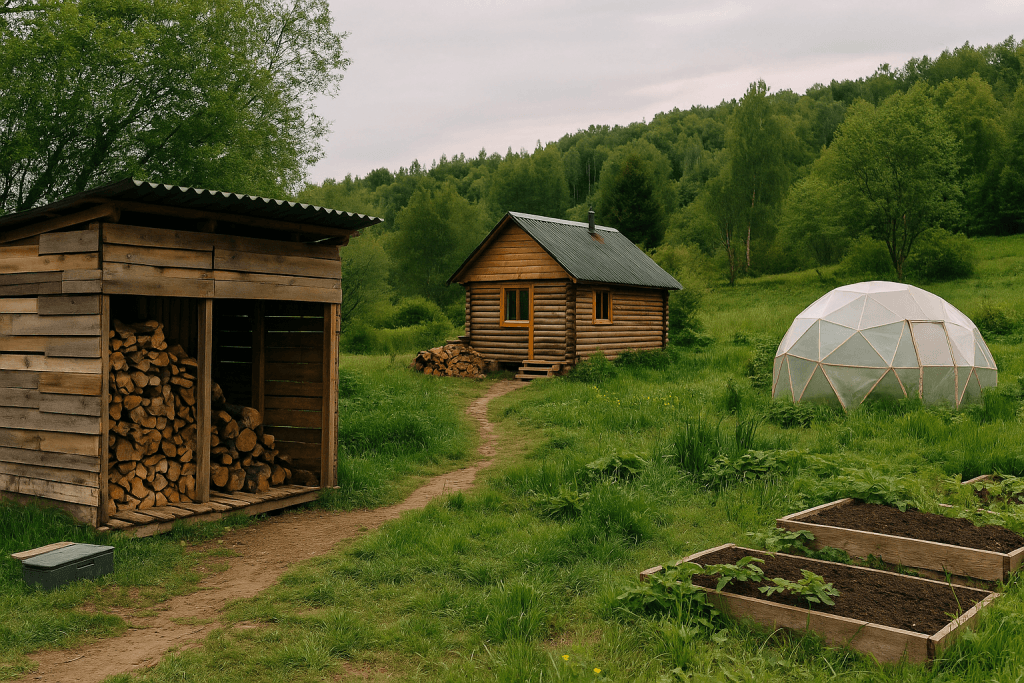
Short answer: usually not as your main home without planning permission. Owning land does not automatically give you the right to live on it in a caravan, static caravan, motorhome or mobile home. Short, occasional stays are treated very differently from living there.
What counts as a caravan in law?
The Caravan Sites Act 1968 defines a caravan as a structure designed or adapted for human habitation that can be moved, by towing or on a vehicle. For a twin-unit caravan the size limits are usually quoted as up to 20 metres long, 6.8 metres wide and 3.05 metres internal height. Something bigger or permanently fixed is treated as a building instead, with building regulations and stricter planning scrutiny.
Do I need planning permission?
Placing a caravan on land and living in it is normally a change of use of the land. That generally needs planning permission. If you are granted permission, the site may also need a caravan site licence from the local authority, and a licence can only be issued for land that has planning permission for use as a caravan site.
What about the “28 days” rule?
In England, national rules allow some temporary uses of land for a limited number of days a year without a planning application. People often read this as “I can live there for 28 days”. It is not that simple:
- It is aimed at temporary, occasional uses, not making a home.
- Some uses depend on the type of land and whether a licence exemption applies.
- Rules in Wales and Scotland are different in detail; check locally.
When is a caravan allowed?
- Ancillary use: a caravan within the grounds of a house, used as part of the household (for example by family), can be permitted development in some cases. It must not be lived in as a separate home.
- While building a house: temporary accommodation on site while you build a home that has planning permission is commonly accepted, but check conditions.
- Licensed caravan sites: a licensed residential site is designed for this.
- Full planning permission: where the council grants residential caravan use, sometimes on a temporary basis, for example in a One Planet Development.
England, Wales and Scotland
The principle is the same across the UK: a site licence normally requires planning permission for a caravan site, and permanent residential use needs consent. The detail differs. In Scotland, sites for year-round residential use are licensed under Part 1A of the 1960 Act, and exemptions for short stays use the same 28-day style limits. Always ask the council that covers your land.
What if there is already a caravan on the land?
Long-standing residential use can, in some circumstances, become lawful and a certificate of lawfulness can be applied for. This depends on evidence of continuous use over many years and is not something to plan a purchase around. If a seller says “it has always been fine”, ask to see proof.
Practical steps
- Check the planning history of the land on your council’s website.
- Ask the planning department what would be allowed, before buying.
- Look at the wider picture: water, drainage, access and neighbours all matter. Our Land & Planning Due-Diligence Pack gives you a repeatable checklist.
- Read planning permission for off-grid homes and is it legal to live off grid in the UK.
FAQ
Can I live in a static caravan on my own land? Only with the right planning permission for residential use, and usually a site licence.
Can I live in a motorhome or campervan on my own land? The same principle applies: living in it as a home is a change of use.
Can I put a caravan on my land for a holiday? Short, occasional stays may be possible; the details depend on the land, the country and how the caravan is used.
Sources
- Caravan Sites Act 1968
- GOV.UK: Caravan site licence
- Town and Country Planning (General Permitted Development) (England) Order 2015
- Planning Portal
General information for the UK, not legal or professional advice. Rules differ between nations and change over time; check with your local planning authority and a qualified professional before acting. Last checked: September 2026.

