The Truth About Buying Land for Off-Grid Living in the UK
Buying land for off grid living UK is one of the biggest dreams beginners have when they first start exploring self-sufficiency.
The logic seems simple enough:
Buy land. Escape the system. Build a cabin. Grow food. Live freely.
And honestly? That dream is understandable.
A lot of people are exhausted with:
- rising living costs
- endless bills
- fragile systems
- urban pressure
- feeling disconnected from practical life
So naturally, land starts to represent something much bigger than just property.
It starts to represent:
- freedom
- security
- control
- space
- a different future
But this is also where many beginners get into trouble.
Because the internet often presents off-grid land ownership like some magical loophole where you buy a field and instantly become a woodland wizard with solar panels and emotional peace.
Real life in the UK is usually more complicated than that.
Land laws matter.
Planning permission matters.
Access rights matter.
Water matters.
Infrastructure matters.
And unfortunately, councils tend to get a bit twitchy when people randomly start building cabins in fields.
That does not mean buying land for off-grid living in the UK is impossible.
Far from it.
But it does mean you need realistic expectations before spending large amounts of money.
The good news is that most expensive mistakes are avoidable if you understand the basics before rushing in emotionally.
Understanding the reality behind buying land for off grid living UK can save beginners enormous amounts of money, stress, and disappointment later.
If you are completely new to the off-grid world, start with the Start Here guide first before making any serious land decisions.
Why Land Becomes the Biggest Off-Grid Obsession
For most beginners, land becomes the emotional centre of the entire off-grid dream.
Many people begin researching buying land for off grid living UK long before they fully understand the legal and practical realities involved.
People often believe:
- “If I can just buy land, I can finally live differently.”
And to be fair, land does create possibilities.
Without access to land, many off-grid systems become difficult:
- food growing
- water collection
- renewable energy
- livestock
- long-term self-sufficiency
But there is also a psychological side to this obsession.
Land represents escape.
It feels tangible.
It feels permanent.
It feels like freedom can finally be bought and secured.
The problem is that many people romanticise land ownership without fully understanding the long-term realities attached to it.
They imagine:
- peaceful woodland cabins
- endless freedom
- simple living
- no restrictions
But they often ignore:
- planning restrictions
- legal limitations
- water access
- flood risk
- road access
- maintenance costs
- infrastructure challenges
This is why beginners sometimes buy unsuitable land purely because it looked cheap, isolated, or emotionally appealing.
That can become a very expensive mistake.
Especially when people discover that buying land for off grid living UK does not automatically mean you can legally live on it.
The Biggest Misunderstanding About Buying Land in the UK
This is probably the single most important thing beginners need to understand:
Owning land does NOT automatically give you permission to live on it.
This is where many off-grid fantasies collide with UK legal reality.
People often assume:
- “If I own the land, I can do what I want.”
In the UK, that is often not true.
Planning permission, land designation, environmental protections, agricultural restrictions, access rights, and local council policies can all affect what is legally possible.
For example:
- agricultural land does not automatically allow residential living
- woodland often comes with strict usage restrictions
- temporary structures may still trigger enforcement issues
- protected land can become extremely difficult to develop
This does not mean buying off-grid land is hopeless.
It simply means beginners need to approach it with research instead of fantasy.
One of the smartest things you can do before buying land for off grid living UK is to understand:
- what the land is legally designated for
- whether access rights exist
- what planning history the site has
- whether utilities or water are nearby
- what restrictions already apply
Many people focus entirely on the purchase price while ignoring the hidden legal and infrastructure realities behind the land itself.
That is often where the real financial pain begins.
For official planning guidance, check the GOV.UK planning permission guidance.
Get the UK Off-Grid Starter Checklist
Simple first steps for starting off-grid in the UK without overwhelm.
No spam. Just practical off-grid starting points.
Common Types of Off-Grid Land in the UK
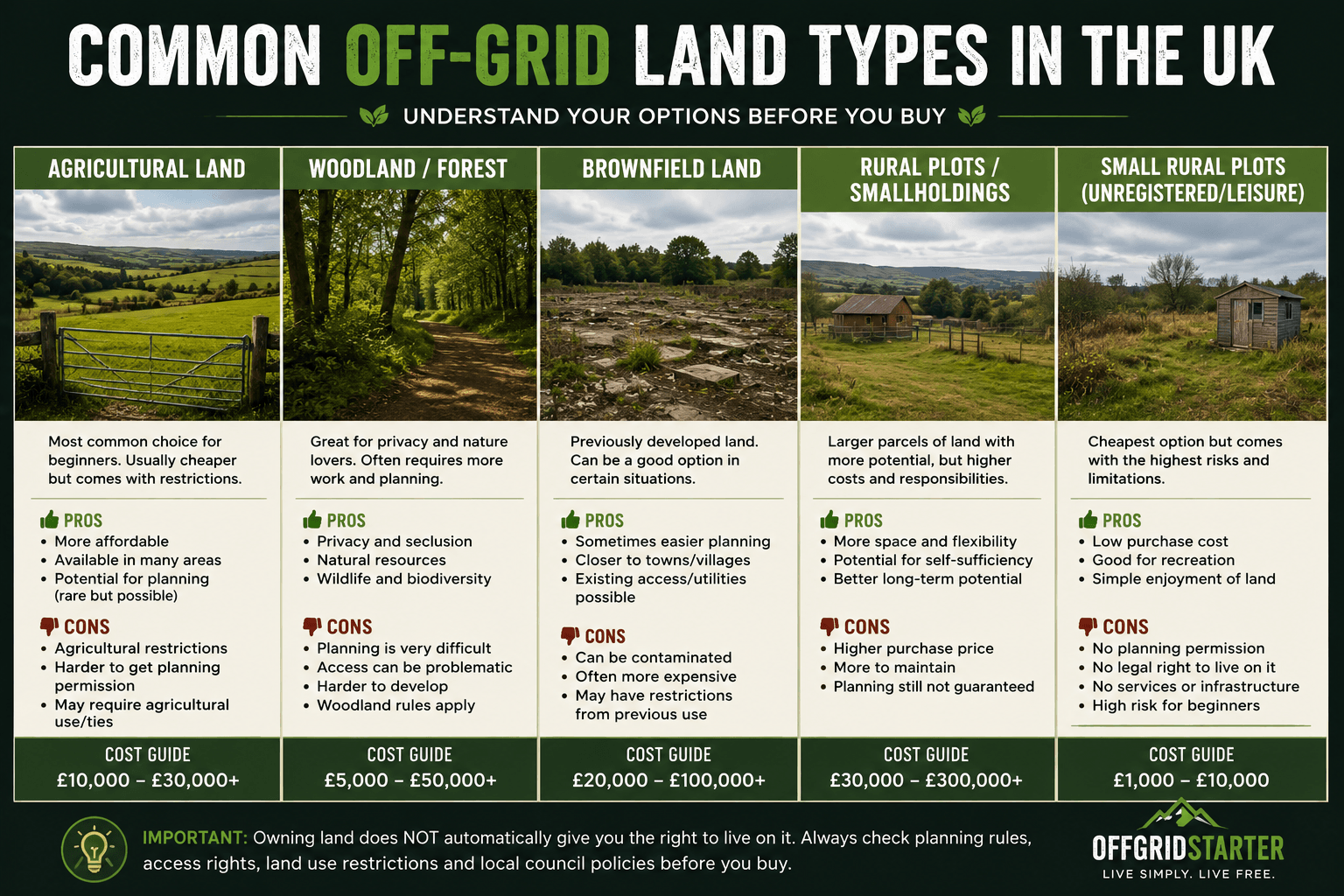
Not all land is equal when it comes to off-grid living.
One of the biggest mistakes beginners make when buying land for off grid living UK is assuming that cheap land automatically means good land.
Anyone considering buying land for off grid living UK should understand that different land types come with very different restrictions and long-term possibilities.
In reality, every land type comes with different opportunities, restrictions, risks, and long-term costs.
Understanding these differences early can save enormous amounts of money and frustration later.
Agricultural Land
Agricultural land is often the first thing beginners look at because it can sometimes appear cheaper than residential land.
It may offer:
- open space
- food-growing potential
- larger plots
- rural locations
But agricultural land also comes with major restrictions.
Owning farmland does not automatically mean you can build a house or live there permanently.
Planning permission can be difficult, especially if there is no proven agricultural business need attached to the land.
This is one of the most misunderstood parts of buying land for off grid living UK.
Woodland and Forest Land
Woodland is extremely attractive emotionally.
Many people dream of secluded cabins hidden among trees with complete privacy and independence.
And honestly, woodland can be beautiful.
But woodland also comes with some of the strictest restrictions in the UK.
Challenges can include:
- protected tree regulations
- limited development rights
- difficult vehicle access
- poor solar exposure
- complicated planning situations
Woodland can work for certain off-grid projects, but beginners often underestimate how difficult it can be to legally develop.
Brownfield Land
Brownfield land refers to previously developed sites.
In some situations, this type of land can offer advantages because there may already be:
- access routes
- utility history
- existing structures
- planning history
However, brownfield land may also come with:
- contamination issues
- cleanup costs
- higher purchase prices
- location limitations
Every site is different.
Smallholdings and Rural Plots
Smallholdings are often one of the most practical long-term routes into off-grid living.
They may offer:
- space for food production
- better infrastructure
- existing buildings
- improved access
- more realistic long-term living potential
But they also tend to cost significantly more.
This is where many beginners start understanding the true financial reality behind buying land for off grid living UK.
Cheap “Leisure” Plots
Cheap rural plots often appear online with phrases like:
- “perfect off-grid opportunity”
- “escape the system”
- “live freely”
Be careful.
Many of these plots:
- have no legal residential rights
- have poor access
- lack water
- cannot realistically support permanent living
- exist mainly for recreation purposes
If something looks unbelievably cheap, there is usually a reason.
That does not mean cheap land is always useless.
It simply means beginners need to understand exactly what they are buying before emotionally committing.
The Hidden Costs Most Beginners Never Think About
One of the biggest traps in buying land for off grid living UK is focusing only on the purchase price.
The land itself is often just the beginning.
Additional costs may include:
- legal fees
- surveys
- access roads
- water systems
- solar infrastructure
- storage
- fencing
- waste management
- planning applications
- drainage
- ground preparation
In some cases, infrastructure costs can exceed the original land purchase itself.
This is why rushing into cheap land purchases without proper research can become extremely expensive later.
Many beginners accidentally buy land emotionally instead of strategically.
That usually creates problems.
Can You Legally Live Off-Grid on Your Own Land in the UK?
This is probably the biggest question people ask after buying land for off grid living UK:
“If I own the land, can I legally live on it?”
The honest answer is:
Sometimes — but it depends entirely on the land, planning rules, and how the site is being used.
One of the biggest mistakes people make when buying land for off grid living UK is assuming ownership automatically gives full residential rights.
This is where many off-grid discussions online become dangerously misleading.
You will often see people claiming:
- “just buy agricultural land”
- “you can live there if nobody notices”
- “temporary structures are always legal”
- “councils cannot stop you”
Reality is far more complicated.
In the UK, planning permission and land use regulations still apply even if you own the land privately.
That means councils may still investigate:
- permanent residential use
- new buildings
- cabins
- containers
- mobile structures
- waste systems
- access changes
This does not mean off-grid living is impossible.
Far from it.
There are people successfully living more independently across the UK through:
- smallholdings
- rural homes
- self-build projects
- low-impact developments
- agricultural businesses
- gradual transitions into self-sufficiency
But successful setups usually involve:
- planning research
- careful site selection
- legal awareness
- long-term strategy
Not fantasy loopholes.
One important example people often reference is the Welsh “One Planet Development” policy.
This allows certain low-impact developments under strict sustainability requirements.
However, many beginners misunderstand this policy completely.
It is not a magical shortcut to free woodland living.
It involves:
- detailed planning requirements
- sustainability targets
- land management expectations
- ongoing compliance
That is why understanding local planning realities before buying land is so important.
For official planning guidance, always check:
GOV.UK planning permission guidance.
What Beginners Should Actually Do Before Buying Land
One of the smartest things you can do is slow down.
Seriously.
Most expensive mistakes happen when people buy land emotionally before understanding:
- planning restrictions
- water access
- infrastructure costs
- solar limitations
- legal access rights
- local council attitudes
The excitement of finding “cheap off-grid land” can cloud judgement very quickly.
Instead, beginners should focus on:
- learning first
- researching areas carefully
- understanding planning systems
- experimenting with smaller projects
- building practical skills
One of the best approaches is to start becoming more self-sufficient before buying land at all.
You can learn:
- food growing
- solar basics
- water storage
- tool use
- energy reduction
- basic repair skills
…without risking tens of thousands of pounds on unsuitable land.
This approach dramatically lowers the chances of making expensive mistakes later.
If you are still exploring the financial side of off-grid living, read:
How Much Does It REALLY Cost to Start Off-Grid Living in the UK?
Biggest Red Flags When Buying Off-Grid Land
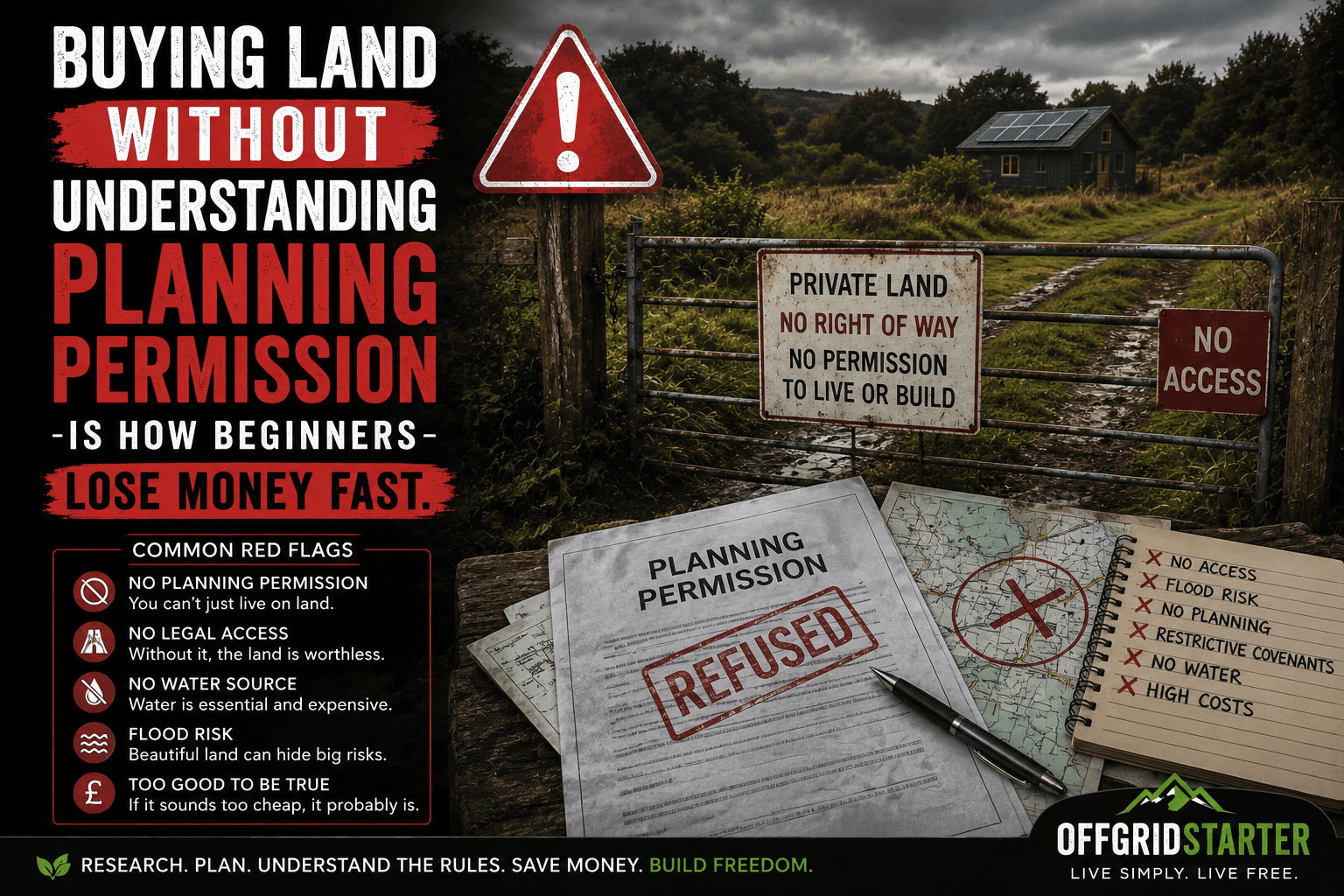
Some land deals look amazing on the surface.
But beginners often miss serious warning signs because they are focused emotionally on the dream instead of the practical realities.
Here are some of the biggest red flags to watch for when buying land for off grid living UK.
No Legal Access
If land does not have proper legal access, you may struggle to:
- reach the site
- move materials
- get emergency access
- develop infrastructure
Never assume access exists just because a track is visible.
No Water Source
Water changes everything.
Without reliable water access, even simple off-grid projects become significantly harder and more expensive.
Always investigate:
- rainfall
- water storage options
- nearby supply access
- ground conditions
Reliable water access is one of the most overlooked parts of buying land for off grid living UK.
Flood Risk
Cheap land is sometimes cheap for a reason.
Flood-prone sites can create massive long-term problems for:
- access
- structures
- food production
- insurance
- drainage systems
Always check flood risk maps before buying.
Impossible Planning Conditions
Some plots may technically allow ownership while being almost impossible to legally develop for residential use.
This is especially common with:
- woodland plots
- isolated agricultural land
- protected areas
Beginners often discover this too late.
Emotional Impulse Buying
This is probably the most common mistake of all.
People see:
- beautiful scenery
- cheap prices
- privacy
- escape potential
…and buy emotionally before understanding the long-term realities.
That can become incredibly expensive later.
Final Thoughts
The reality of buying land for off grid living UK is far more manageable when approached slowly, realistically, and with proper research.
Buying land for off grid living UK is not impossible.
But it is also not the simple freedom fantasy many people imagine online.
The people who succeed long term usually approach it slowly, realistically, and strategically.
They:
- research carefully
- learn practical skills
- understand planning systems
- avoid emotional decisions
- build gradually
That may sound less exciting than the internet version of off-grid living.
But it is far more sustainable in real life.
You do not need to solve your entire future this year.
You simply need to make better decisions than most beginners make.
That alone puts you ahead.
Want a More Structured Beginner Roadmap?
If you want a calmer and more realistic introduction to off-grid living in the UK, explore
The Beginner’s Guide to Sustainable Off-Grid Living in the UK.
It covers:
- beginner priorities
- planning realities
- off-grid systems
- common mistakes
- practical first steps
No hype. No fake guru nonsense. Just a more grounded starting point.
FAQ: Buying Land for Off-Grid Living UK
Can you legally live off-grid on your own land in the UK?
Sometimes, but owning land does not automatically give you permission to live on it. Planning permission and land use regulations still apply.
Can you live on agricultural land in the UK?
Not automatically. Agricultural land often comes with strict restrictions regarding permanent residential use.
Is woodland good for off-grid living?
Woodland can be attractive, but it often comes with planning restrictions, limited solar access, and environmental protections that beginners underestimate.
What is the cheapest type of off-grid land?
Cheap agricultural or leisure plots are often the least expensive, but they may also come with serious development and legal limitations.
Do you need planning permission for off-grid living in the UK?
In many cases, yes. Structures, permanent residential use, access changes, and waste systems may all involve planning requirements.
Use the Land & Planning Due-Diligence Pack to turn the ideas in this guide into a practical working plan.

