
7 Things I Wish I Knew Before Exploring Off-Grid Living in the UK
Off grid living UK is one of those ideas that instantly captures people’s imagination.
The dream usually starts the same way.
You get tired of:
- rising bills
- constant pressure
- fragile systems
- feeling trapped in routines that do not actually feel sustainable
Then you discover videos about:
- cabins in the woods
- solar power
- food growing
- tiny homes
- self-sufficiency
And suddenly off grid living UK starts to feel like the answer to everything.
Honestly, that reaction makes sense.
There is something deeply appealing about building a simpler and more resilient life.
But one thing I wish I understood earlier is this:
Off grid living UK is usually far less about escaping society and far more about building better systems for everyday life.
That shift in thinking changes everything.
Because once the fantasy fades, you start realising:
- food still needs growing
- water still needs managing
- energy systems still break
- planning rules still exist
- the weather still tries to emotionally damage you for six months of the year
And yet strangely… that realism is what makes off grid living UK more meaningful long term.
It stops becoming a fantasy escape plan and starts becoming a practical resilience strategy.
If you are completely new to this world, start with the Start Here guide before making any expensive decisions.
1. Off-Grid Living Is More About Systems Than Escaping Society
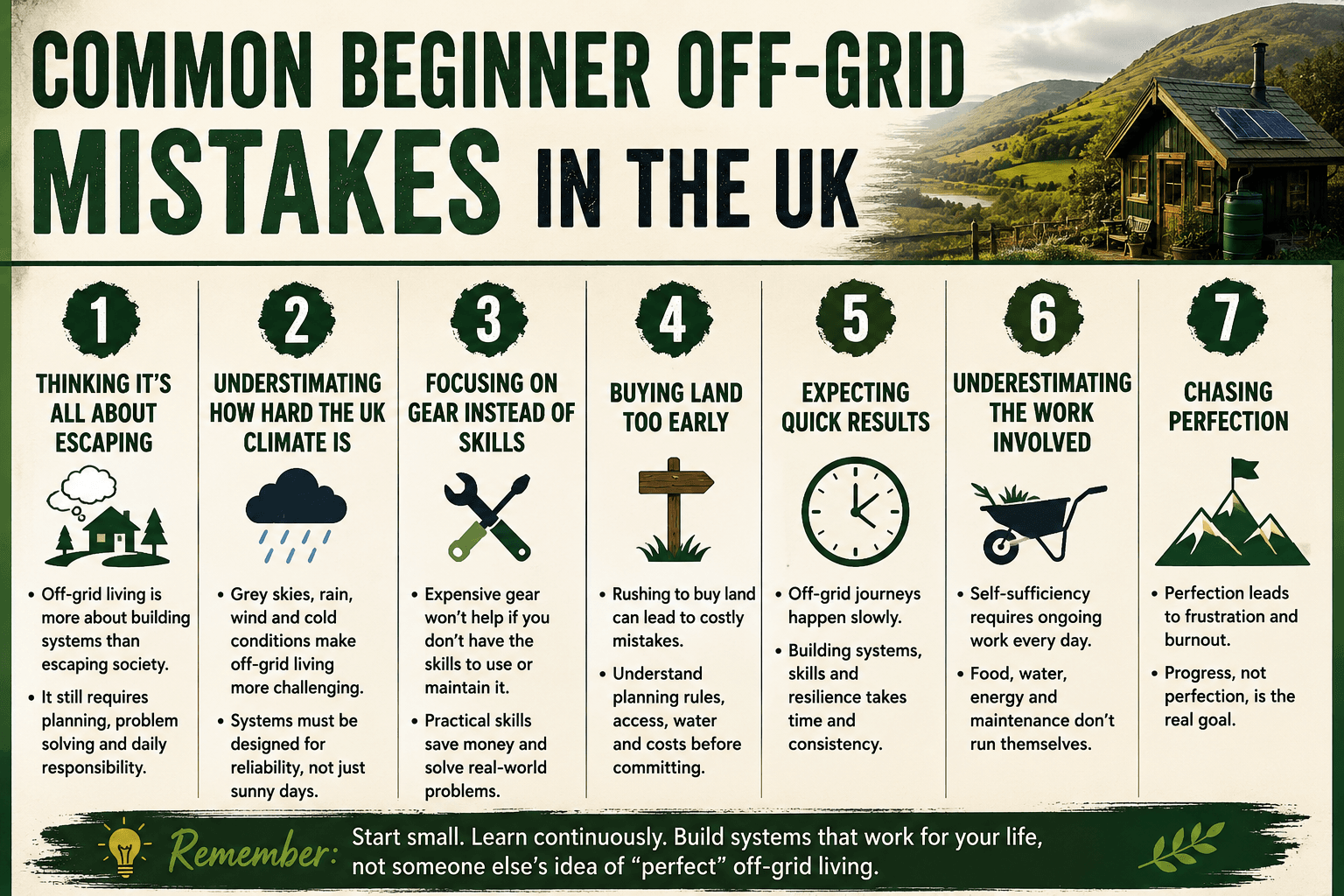
One of the biggest misconceptions about off grid living UK is the idea that it is mainly about “escaping the system”.
You hear that phrase constantly online.
Escape the grid.
Escape society.
Escape modern life.
But the longer you explore off grid living UK, the more you realise that successful off-grid living is actually built on systems.
Real systems.
Not fantasies.
You still need:
- water systems
- energy systems
- food systems
- waste systems
- financial systems
- maintenance routines
The difference is that you become more directly responsible for those systems yourself.
That can feel incredibly empowering.
But it also means more responsibility, more learning, and more long-term thinking.
Many beginners imagine off-grid living as a permanent holiday in a woodland cabin.
Real life usually looks more like:
- fixing water pumps in bad weather
- checking battery levels
- stacking firewood
- managing food production
- learning practical skills continuously
And honestly?
That is not a bad thing.
Because one of the biggest benefits of off grid living UK is reconnecting with practical reality again.
You begin understanding how the systems supporting your life actually work.
That creates a very different relationship with:
- energy
- food
- waste
- consumption
- time
Ironically, the people who succeed long term are usually not the people trying to “escape everything”.
They are the people building stable systems slowly and realistically.
2. The UK Is One of the Hardest Places to Go Fully Off-Grid
This is something I genuinely wish more people explained honestly.
Off grid living UK is possible.
But the UK is also one of the more difficult countries to go fully off-grid compared to many places online.
A lot of off-grid content on YouTube and social media comes from:
- large American homesteads
- vast rural land
- warmer climates
- areas with fewer planning restrictions
The UK is different.
Land is expensive.
Planning permission is strict.
The weather is often wet, grey, windy, and deeply committed to ruining your solar expectations in winter.
And because the UK is relatively densely populated, privacy and isolation are harder to achieve than many beginners expect.
This does not mean off grid living UK is hopeless.
Far from it.
But it does mean you need realistic expectations early on.
One of the biggest mistakes beginners make is assuming they can instantly recreate an American-style homestead setup in rural Britain without understanding:
- planning laws
- land restrictions
- water management
- solar limitations
- infrastructure costs
This is exactly why rushing into land purchases can become expensive.
If you are exploring land options already, read:
The Truth About Buying Land for Off-Grid Living in the UK.
Understanding the reality of off grid living UK early will save you far more money and stress than chasing unrealistic expectations later.
3. Skills Matter More Than Expensive Gear
One of the most important lessons I learned about off grid living UK is that skills usually matter far more than expensive equipment.
Beginners often assume the answer is buying more gear.
More solar panels.
More gadgets.
More survival tools.
More expensive setups.
But expensive gear does not automatically create resilience.
A beginner with thousands of pounds worth of random equipment can still be less capable than someone with:
- basic practical skills
- patience
- adaptability
- problem-solving ability
That becomes obvious very quickly once systems fail.
And eventually, systems always fail.
Batteries degrade.
Pipes freeze.
Solar output drops.
Tools break.
Water systems clog.
Generators throw emotional tantrums at the exact moment you need them most.
That is why successful off grid living UK depends heavily on learning how things actually work.
Useful beginner skills include:
- basic electrical understanding
- water storage management
- food growing
- tool maintenance
- simple repairs
- budgeting
- resource management
Ironically, many of these skills can be learned before you ever buy land or build a cabin.
You do not need a perfect off-grid setup to start becoming more capable.
You can start where you are now.
That mindset shift is huge.
If you are still trying to understand realistic costs, read:
How Much Does It REALLY Cost to Start Off-Grid Living in the UK?.
Get the UK Off-Grid Starter Checklist
Simple first steps for starting off-grid in the UK without overwhelm.
No spam. Just practical off-grid starting points.
4. Buying Land Too Early Can Become a Huge Mistake
This one surprises a lot of people.
But one of the biggest mistakes beginners make with off grid living UK is rushing to buy land before they understand what they actually need.
Land becomes emotionally powerful very quickly.
People start imagining:
- peaceful cabins
- privacy
- freedom
- escape from pressure
And because of that emotional pull, beginners often buy unsuitable land far too early.
That can create major problems later.
Some people buy:
- land with no legal access
- flood-prone sites
- woodland with strict restrictions
- agricultural land with no residential permissions
- isolated plots with huge infrastructure costs
Then reality arrives.
Suddenly:
- water systems become expensive
- planning becomes difficult
- solar performance is poor
- access roads become a nightmare
- development costs explode
This is why successful off grid living UK usually starts with education first.
Not emotional land purchases.
One of the smartest things you can do is spend time learning:
- planning realities
- water systems
- solar basics
- food growing
- land restrictions
- practical maintenance
…before rushing into major financial commitments.
If you are exploring land already, read:
The Truth About Buying Land for Off-Grid Living in the UK.
That article will save many beginners from making very expensive emotional decisions.
5. Most Off-Grid Journeys Happen Slowly
This is probably one of the healthiest things I wish I understood earlier about off grid living UK.
Most successful off-grid journeys do not happen overnight.
The internet often pushes dramatic transformation stories.
Sell everything.
Move to the woods.
Build a cabin.
Disappear from society.
Become emotionally bonded to a wood burner by next Tuesday.
Real life is usually slower than that.
And honestly, slower is often better.
Most sustainable off grid living UK setups are built gradually over time.
People slowly:
- reduce dependence
- build skills
- learn systems
- improve finances
- experiment with self-sufficiency
That slower approach gives people room to:
- make mistakes safely
- adapt realistically
- avoid huge financial disasters
- build confidence gradually
Ironically, trying to rush into full off grid living UK too quickly is often what causes burnout.
Because people suddenly realise:
- everything takes longer
- systems fail
- weather affects everything
- money disappears faster than expected
- self-sufficiency requires ongoing work
The healthiest mindset is usually:
- build slowly
- learn constantly
- improve systems over time
You do not need to become fully off-grid immediately to begin creating a more resilient life.
Even small changes matter.
6. Self-Sufficiency Is Harder — and More Rewarding — Than It Looks
One thing that surprised me about off grid living UK is how physically and mentally demanding self-sufficiency can become.
From the outside, it often looks peaceful and simple.
And sometimes it genuinely is.
But there is also constant responsibility involved.
Food needs managing.
Water needs monitoring.
Systems need maintaining.
Energy usage needs thinking about.
Weather affects almost everything.
And unlike modern convenience systems, you cannot always ignore problems until later.
Off-grid systems force you to pay attention.
That can feel overwhelming initially.
But strangely, it can also feel deeply satisfying.
Because one of the hidden benefits of off grid living UK is that it reconnects people with practical responsibility again.
You stop becoming disconnected from the systems supporting your life.
You start understanding:
- where energy comes from
- how water is stored
- how food grows
- how waste is managed
- how fragile modern convenience can be
That awareness changes people.
And although self-sufficiency is harder than many beginners expect, it is also often more meaningful than they imagined.
Especially once you stop chasing perfection.
7. The Biggest Win Is Usually Peace of Mind, Not Perfection
One of the biggest myths around off grid living UK is the idea that the goal is complete independence.
For some people, maybe it is.
But for most ordinary people, the real goal is usually something simpler:
more resilience, more control, and more peace of mind.
That is a very different mindset.
Because suddenly:
- growing some food matters
- learning practical skills matters
- reducing dependence matters
- understanding your systems matters
You stop viewing success as some perfect fantasy version of off-grid living.
You start viewing success as becoming slightly more capable and resilient over time.
That shift removes huge amounts of pressure.
And honestly, it makes off grid living UK feel far more achievable.
The internet often encourages all-or-nothing thinking.
Either:
- live completely off-grid
- or do nothing at all
Real life is not like that.
Most people build resilience gradually.
And that still matters enormously.
Sometimes the biggest off-grid win is simply knowing:
- you are less dependent
- more prepared
- more capable
- more connected to reality
That alone can change how life feels.
Final Thoughts
Off grid living UK is not a perfect fantasy escape.
And honestly, that is probably a good thing.
Because once you move beyond the fantasy version, you start discovering something more valuable:
- practical resilience
- useful skills
- greater awareness
- better systems
- more intentional living
The people who thrive long term are usually not the people chasing perfection.
They are the people willing to:
- learn slowly
- adapt realistically
- build systems patiently
- accept discomfort occasionally
That path may look less glamorous online.
But it is usually far more sustainable in real life.
If you are still exploring the basics of off grid living UK, start with the
Off Grid Living UK FAQ.
Want a More Structured Beginner Roadmap?
If you want a calmer and more practical guide to starting off grid living UK, explore
The Beginner’s Guide to Sustainable Off-Grid Living in the UK.
It covers:
- beginner priorities
- UK planning realities
- self-sufficiency basics
- common mistakes
- practical first steps
No hype. No fantasy. Just a more grounded starting point.
FAQ: Off Grid Living UK
Is off grid living legal in the UK?
Yes, but planning permission, land use rules, and building regulations still apply depending on the type of setup and location.
How much does off grid living UK cost?
Costs vary massively depending on land, shelter, energy systems, water infrastructure, and how self-sufficient you want to become.
Can you live completely off-grid in the UK?
Some people do, but the UK can be challenging due to planning restrictions, weather, land prices, and infrastructure costs.
What is the biggest mistake beginners make with off grid living UK?
Many beginners rush emotionally into land purchases or expensive systems before building practical skills and understanding long-term realities.
What is the best way to start off-grid living?
Most people should start gradually by learning practical skills, reducing dependence, experimenting with small systems, and improving resilience over time.

